MONEY VS SHAME

The difference between shame and guilt, is the difference between ‘I am bad’ and ‘I did something bad’.

-Brené Brown

A little boy is at school laughing with some friends. He has pretty good relationships at school. He’s funny and can make people laugh. School comes easy to him, so he’s able to help people with their homework. He’s pretty fast and good at hand sports, so he likes to be active with others. He reads pretty well and likes to learn from others who share his hobby of reading comic book characters.

When he leaves school, though, he is mostly a loner. There are a couple of kids in the neighborhood that he hangs out with, but he never hangs out with kids from school. While in school, he would overhear others talking about sleeping over at each other’s houses. He is never invited over to anybody’s house. The flipside, though, is that he never invites people over to his place.

It seems to him that all of the kids at school live in large houses in fancy areas of town that have fancy names. The story he tells himself is that when kids stay over at each other’s houses, they stay up all night in large basements playing Sandbox and drinking Ribenna and Lucozade. He doesn’t have a large basement, nor a Sandbox, nor a mansion.

He doesn’t invite people over because he is somewhat ashamed. He wonders what would happen if they said no. He wonders what they will tell all the other kids when they find out he lives in a bungalow and not a mansion. What would they think of him if they find out he has no Sandbox and no Ribenna or Lucozade drink?

Shame kept this little boy from having more friends than he did. He wrapped himself in a shame bubble.

I know that little boy well because that boy was me.

WHAT IS SHAME?

According to Karen Reivich and Andrew Shatte in their book The Resilience Factor, shame is related to beliefs about being a bad person. It’s about character rather than behavior. People who are ashamed tend to be people who characterize themselves as being flawed or imperfect. In addition, they think that it’s their fault.

Shame is toxic and, to the extent we have any control over it, ought to be avoided at all costs. It causes helplessness and powerlessness and gives people an external locus of control, making them think that their lives are outside of their control. It tends to get people into a downward spiral that’s hard to get out of.
SHAME ENHANCING THE INCENTIVE VALUE OF MONEY

Shame leads to devaluation of the social self, and thus to a desire to improve self-esteem. Money, which is related to the notion of one’s ability, may help people demonstrate competence and gain self-esteem and respect from others. Based on the perspectives of feelings-as-information and threatened ego, I tested the hypothesis that a sense of shame heightens the desire for money, prompting self-interested behaviors as reflected by monetary donations and social value orientation.

The results showed that subjects in the shame condition donated less money (Experiment 1) and exhibited more self-interested choices in the modified decomposed game (Experiment 2). The desire for money as reflected in overestimated coin sizes mediated the effect of shame on self-interested behavior. My findings suggested that shame elicits the desire to acquire money to amend the threatened social self and improve self-esteem; however, it may induce a self-interested inclination that could harm social relationships.

SHAME VERSUS GUILT

Shame is a close relative of guilt. Both shame and guilt have to do with people wishing that something was a little different. Often they wish there was something that they could change in the past. The difference, though, is that guilt is about a particular behavior. Somebody who feels guilt feels like they have done something bad. Shame is about being a bad person.

Both of them are uncomfortable, but guilt is easier to rectify. Guilt points us to something that we can do. Guilt tells us there’s somebody we can apologize to or something we can stop doing. Shame doesn’t have a specific behavior attached to it. If you don’t have a specific behavior attached to it, you don’t know how to rectify it as easily as it would have been.

LOOK FOR GUILT

Guilt and shame are often used interchangeably. If you’re feeling uncomfortable feelings and think it’s shame, it might be worth trying to see if you can find some guilt. Guilt is better for you. Guilt will give you a problem to solve; a challenge that you can try to overcome.

CHALLENGE AUTOMATIC THOUGHTS

Often people feel ashamed or embarrassed because they see themselves as a failure at a deep level. These feelings are often driven by automatic thoughts. Our automatic thoughts are almost always going to skew negative, and that’s because of our ingrained negativity bias. It takes work to overcome this negativity bias, but it starts with trying to get a handle on what story you’re telling yourself. In other words, what money scripts in financial therapy are driving the thoughts about shame? Once you know what your actual belief is, you can challenge those beliefs and those automatic thoughts. You can ask yourself if you’re overgeneralizing, for example, or catastrophizing. Sometimes it’s difficult to challenge beliefs when they are yours, so you can ask yourself what advice you would give a close friend if that person came to you with the exact same situation.

FOCUS ON WHAT YOU CAN CONTROL

It’s helpful to remember that you can’t change anything that’s happened in the past. The only thing you can do is learn from it. It’s also reassuring to learn that many things are outside of our control. For example, you can’t change the cards you were dealt in life; that is outside your control. What is in your control is how you play the hand; you can change what you do going forward.

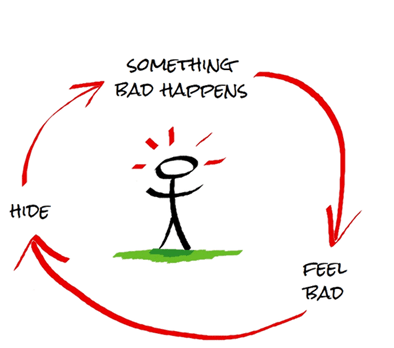
Shame is menacing. Once we get into a shame cycle, it’s hard to get out of. It’s helpful to try to reframe our shame as guilt if at all possible. If we can point to a specific behavior or set of behaviors that we’ve done, then we can do something to rectify what we’ve done. Shame is often driven by automatic beliefs that are tilted towards the negative side. Learning to understand and challenge these automatic beliefs will help us determine if we are jumping to the wrong conclusions. Finally, remember that some things are in your control and some things are not. Take responsibility for those things that are in your control and let go of things that are not. You can’t change the past, but you can do something today and tomorrow to alter your future.

What will you do?
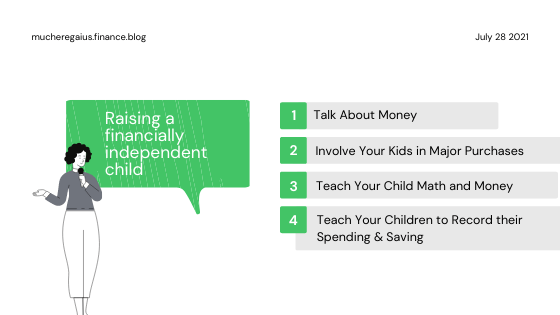
Raising a financially independent child

mucheregaius.finance.blog

As any other parent, you may be wondering how you can set your children up for financial freedom “process by process without getting naive” on whether they’ll catch up.

Coming out of the COVID-19 crisis might be a time to consider sharing valuable life-lessons about money with your children.

And when we think about July 2021 being “Make a Difference to Children” month, life lessons about handling money are perfect to share!

Here are some tips that will show you how to raise a financially independent child.

Talk About Money

Let’s change the narrative around money.  You can introduce the concept of money to your kid at an early age.  As your child grows, continue to deepen the conversation and help him or her understand the concepts of money.

If your unsure of where to start, you can also ask a trusted friend or family member to have these conversations with your child.  It’s also ok to let your child know that you don’t have it all figured out.  Explain the things you’ve done and what you would or wouldn’t do again and why.  Sharing is how we learn!

Involve Your child in Major Purchases

Deciding where to go on vacation?  Buying a new appliance?  Include your kids in the process. They can help with the research.  You can show your child the factors that go into making the decision.  You can help him or her compare the options before making the purchase.  Even better, allow your child to pay for the major purchase.  Imagine how your child will feel knowing they did the research to make the best decision for the entire family. Just imagine that!!!

Teach Your Child Math and Money

Most people don’t learn about budgeting until it’s too late.  Imagine what the future will look like for your child, if you teach him the value of savings today. Show them how compound interest works or much more if you don’t know about it, talk to a friend or family member to take them through indirectly under your guidance. When you go to the store, could you give your child a UGX 100,000 bill and ask them to purchase part of the grocery list?  When could you teach your child about credit?  Could you educate him about how ATM cards work before they go to college?

Teach Your Children to Record their Spending & Saving

I personally my dad used the envelope system.  He taught me to write my spending on a receipt and then separate out my money, based on different expenses, into envelopes.  My mom used a small notebook to record her spending and saving.  To this day, my mom still carries that small notebook in her small African hand bag.  She records her pay, spending, and net worth. Watching my parents instilled this practice in me.

Remember the main reason for teaching your child about how to track their spending is to allow them to better understand where their money goes.  More importantly, this allows your child to successfully handle his money and achieve his goals.

Don’t worry, teaching your child about money doesn’t have to be a daunting task.  If you’re like most people, the hardest thing to do is to start the conversation.

How Banks Are Affected by the Stock Market

Hello hello hello, it’s been two weeks since I last posted something. But well I’m glad I have finally. Many of my followers actually kept on asking me what impact does the stock market have on Banks around the world.

To begin with, Banks have always been affected by the stock market from way back. The Great Depression began with a stock market collapse. However, it is now widely held that what turned a stock market dive into the worst depression in U.S. history was the ensuing collapse of U.S. banks and the resulting contraction of the money supply. There are historic reasons for the perceptiveness of the banking industry to the stock market, but in the 21st century new credit markets and new ways of leveraging capital increase that perceptiveness.

Retail Banks and Lending

Bank stocks loosely correlate with consumer cyclicals; stocks of companies that outperform the market in good times and under-perform in bad times. In a soaring stock market, economic activity increases. Consumers and businesses borrow money for capital investment and consumer purchases. When the stock market falls, automatically businesses and consumers lose confidence, and economic activity slows down. Businesses and consumers borrow less too. As the economy contracts, fewer customers qualify for loans. Banks are often hit again in this downturn, when many consumers can no longer pay their mortgages.

Investment Offerings

Retail banks almost on a daily increasingly offer their customers investment services. Merrill Lynch, for many years one of Wall Street’s larger brokerage and investment houses, is now an integral part of the Bank of America as an American example. When the stock market falls, investment activity slows down and retail banks with brokerage functions are antagonistically affected. In a rising market, the reverse is true.

Recovery Hazards

Falling stock markets are clearly hazardous for banks like Equity Bank, Bank of Africa, Housing Finance Bank and ABSA relating to East Africa, but in some circumstances the economic and political initiatives promoting economic recovery can also pose problems. In a thoughtful 2013 Forbes article, Jerry Bowyer demonstrates that various government activities designed to keep interest rates low to stimulate economic recovery initially cause the stock market to rise, but ultimately weaken the recovery and contribute to rising interest rates. Both predicaments are generally bad for banking. Bowyer likens what happens to a beach ball resting on water. The farther down you push the ball, the higher it rises when you remove your hands. In 2013, for instance, hints that the Fed’s low interest rate policies might soon come to an end sent the stock market into a series of momentary dives, accompanied by significant rises in bond rates.

Investment Banking

In the 21st century, investment banks like Goldman Sachs and Lehman Brothers bought and sold highly-leveraged sub-prime real estate debt instruments that generated enormous profits until 2008, when a real estate boom collapsed and they generated even larger losses. The failure quickly spread to the stock market and then to the greater economy. Banks suffered at every stage of this collapse. Many, like Lehman, went bankrupt, and others struggled to survive.

Are you an Alpha or Beta Investor?

mucheregaius.finance.blog

One of the biggest debates in the investing community is whether the average investor should look for alpha or beta outcomes from his or her portfolio.

What’s the difference? Let’s take a look at each investment strategy and then you can finally decide which one best fits your needs.

The Alpha Investor

During financial forums and conventions, you’ll often hear active investors refer to their “alpha.” This is predominantly the amount by which they have exceeded (or underperformed) their benchmark index. For instance, if you invest primarily in Ugandan stocks, you might use the All Share Index(ALSI) as your benchmark.

For instance if the (ALSI) was up 5% over a given period of time, but your portfolio was up 8%, your alpha would be +3. If, on the other hand, your portfolio was only up 3%, then your alpha would definitely be -2. Alpha is basically the amount by which your return beats or lags an index with a homogenous risk profile.

Most investors, given the choice, would love to beat the index every year. Why would you want to settle for corresponding the index when you could actually try to exceed it? Precisely, beta investors might contend that very few, if any, active managers regularly beat the index, and that many actually under-perform. So, why even bother trying hard?

The Beta Investor

“Beta” refers to the degree to which a given investment or portfolio is more or less volatile than its benchmark index. A fund with a beta coefficient of 1 implies that it will move with the market. A fund with a beta of less than 1 will be less volatile than the market; a fund with a beta higher than 1 will be more volatile than its benchmark index.

Over the years, I’ve got to realise that beta investors are usually passive investors. They are not looking to outperform the markets. They prefer to take the, “If you can’t beat them, join them,” approach to investing. They will accept returns that merely match the index of their choice because they expect that markets will rise amidst their investing lifetime, as they have historically.

That begs the question: what if those historical trends don’t hold true any longer? What if markets take a dip, notably within a few years of retirement? One of the problems with corresponding the index is that you’re definitely going to have periods of negative returns. You can actually lose money over lengthy periods of time, as many passive investors have during the 2000 to 2010 time frame following different financial journals.

Beta investors would purely remind us that we need to reduce our investment risk tolerance as we age so that we’re not heavily invested in stocks during the 5 years before we retire (i.e. personal investment portfolio asset allocation). They would also forewarn that, for this strategy to work, you need to be able to sit tight through the downturns. If you sell during those drawdown periods, you’re presumably to end up with negative returns. To match the index, you have to stay with it.

Absolute Returns

Many investors, including myself, aren’t desperately concerned with how they perform relative to any index. They just want to see their hard-earned cash advance in growth over time with smart investment decision-making choices. Losing 8% in a year when the market was down 14% is cold comfort to the absolute return investor.

Absolute returns simply refer to the amount your portfolio has gone up or down over a given period of time, disregarding how any index performed over that time frame. But then how do you achieve consistently positive absolute returns? There are assumably hundreds of answers to that question. The key is to find the investment strategy that works for you.

Which Is Better?

Both alpha and beta investors can be very glowing about defending their chosen investment strategy. Alpha investors contend that many people can and do beat the indices quite on a regular basis. They are not interested in simply corresponding the index, and they hate the idea of losing money.

Beta investors conceive that the broad stock market indices will be positive over time, so they are comfortable gradationally adding to their positions and sitting tight for the long term. They conceive that negative returns for a short period of time are part of the cost of investing. They’re confident they’ll be ahead and have the money they need to retire with time.

Why not try a Hybrid Approach then

Some investors are hardwired to search for alpha. Others don’t trust in their ability to achieve alpha, so they take the beta route. Both are agreeable as long as they’re working. If you’re trying to use a beta investing strategy, but you just can’t keep your fingers off the sell button, you may want to look at some alpha strategies or even try a hybrid approach.

There are endless combinations of hybrid investment strategies. You could disect your investment capital into two pools, using a beta strategy with half and an alpha strategy with the other half. See which one consummates better over the course of a year. Which one made you feel more convenient? Could you try out a different alpha strategy to see if it works better for you?

Final Word

In the end, investors need to put their money to work in a way that appropriates their age, skill set, income, and risk tolerance. It can take some time, but finding what works for you is the best way to beseem a successful investor.

Now Sir/Madam what’s your investment strategy: alpha, beta, or hybrid?

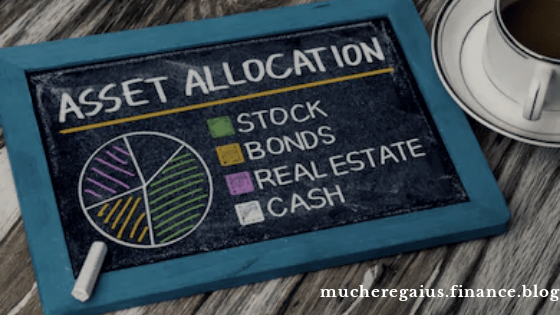
Asset Allocation

Occasionally you spend sleepless nights worrying about which stocks to buy and which to sell, which funds to own and which to dump and whether to procure bonds.

All of these are lawfully begotten concerns, but the greatest determinant of your success as an investor will not be your perceptiveness in selecting specific stocks, bonds and fund’s for your portfolio.

No, it will be your asset allocation.

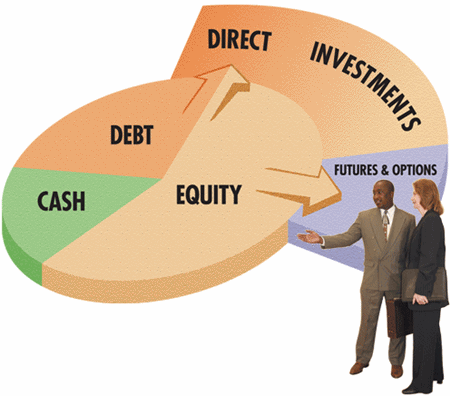
Enormously is, the way you slice up your portfolio into broad categories of, say, large-cap growth stocks and value stocks and triple A bonds and so on.

There are many opportunities available to today’s investor all-over the World.

Taking advantage of these opportunities by strategically distributing your money in a number of different instruments can protect your portfolio and improve your chances of accomplishing a desired return.

It is significant for investors to understand that diversification in building a balanced portfolio helps reduce risk and improve returns.

Asset allocation is yet another way to diversify.

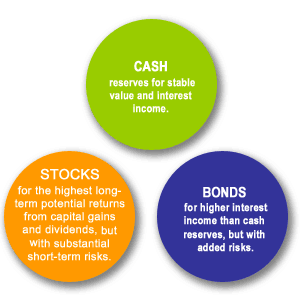
It takes advantage of the fact that when it comes to risk and compensation, financial categories like stocks, bonds and money-market (cash equivalent) accounts all demean quite differently!

Stocks, for instance, offer the highest returns among those three “asset classes,” but remember they also carry the highest risk of losses.

Bonds aren’t so moneymaking, but they offer a lot more stability than stocks.

Money-Market returns are puny, but you’ll never lose your initial investment.

An asset-allocation strategy looks at your particular goals and specialities and determines what asset mix gives you the optimal blend of risk and compensation.

Asset allocation is a process that you re-visit again and over again as you continue to build your portfolio throughout your life.

Inarguably learn to identify the events that can indicate a period of re-evaluation of your asset allocation!

Fortunes are that, over time, the value of your investments in stock will grow more quickly than that of your investments in bonds and cash equivalents.

Ultimately you will likely have a larger percentage of your money invested in stocks than your original strategy confided.

When this situation supervenes, your portfolio could be exposed to more risk.

Now to help ensure that your assets are invested appropriately, sporadically you do have to rebalance your investments!

Design a site like this with WordPress.com
Get started